
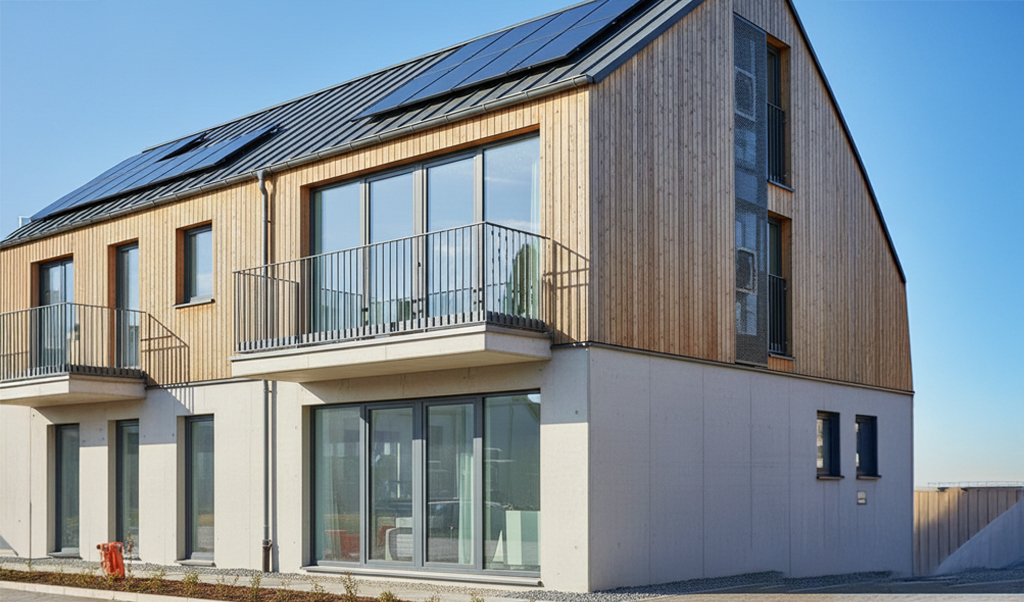
As we move into 2026, expectations around housing and building performance are shifting across the industry.
Through our conversations with developers, councils, consultants and project teams, we’re seeing the focus move away from what systems are specified and towards how buildings actually perform once people move in.
Based on what we’re seeing across live projects, here are five shifts shaping how buildings will be designed and delivered through 2026 and beyond.
- Performance is replacing compliance as the real benchmark
Across developers, councils and housing providers, there is growing fatigue with buildings that are technically compliant but operationally disappointing. You can expect:
- Greater attention to how buildings operate after handover
- More discussion around energy bills, comfort and overheating
- A shared acknowledgement that strong design intent doesn’t always translate into lived experience
As a result, performance is becoming a decision-making driver, not just a regulatory checkbox. Looking ahead, we expect 2026 to further embed a shift towards outcomes in use – with comfort, energy efficiency and indoor air quality carrying greater influence alongside traditional compliance metrics.
- Ventilation has moved into the spotlight
Ventilation is no longer treated as background infrastructure. Across sectors, we’re seeing heightened concern around:
- Indoor air quality
- Overheating risk
- Occupant wellbeing
- Long-term energy efficiency
As airtightness improves, the importance of effective, efficient ventilation with heat recovery is becoming more widely understood – not just by engineers, but by clients and project managers.
MVHR is becoming a core performance system, not a regulatory afterthought.
- Passivhaus thinking is quietly becoming mainstream
Not every project is pursuing Passivhaus certification, but Passivhaus thinking is becoming far more common. We’re seeing clients and project teams adopt:
- Fabric-first design logic
- Integrated services strategies
- Simpler, more predictable building systems
- A focus on long-term operational stability
Alongside this, there is a noticeable increase in training and upskilling across the supply chain. More operatives are being trained to understand airtightness, ventilation, commissioning and integrated building services, helping ensure that low-energy design intent is delivered properly on site.
The priority is shifting towards confidence in long-term performance – consistent comfort, affordable operation and predictable outcomes. We expect this approach, supported by better-trained site teams, to continue gaining traction through 2026 as energy and operational costs remain front of mind.
- Councils are thinking in lifecycles, not just capital cost
Local authorities and housing providers are under pressure to deliver buildings that:
- Are affordable to run
- Support health and wellbeing
- Don’t require major retrofit within a decade
- Stand up to public and political scrutiny
We’re seeing increasing interest in systems that reduce long-term risk by:
- Delivering stable indoor conditions
- Minimising energy demand
- Simplifying maintenance and operation
Looking forward, lifecycle performance is becoming a decisive factor in procurement and that trend will only accelerate as budgets tighten and expectations rise.
- Project teams are pushing back against complexity
Complexity is becoming one of the industry’s biggest pain points. We’re seeing project managers push back on:
- Over-engineered solutions
- Multiple disconnected systems
- Blurred responsibility at commissioning and handover
There is a growing appetite for integrated approaches; where ventilation, heating and energy performance are designed to function cohesively. In 2026, we expect clarity and simplicity to become valued just as highly as innovation.
Looking ahead
What stands out as we enter the new year is that the industry isn’t chasing something radically new. It’s refining what already matters:
- Better performance
- Better comfort
- Fewer surprises after handover
The next phase of low-energy building will be shaped less by bold claims and more by confidence – built on systems, strategies and experience that deliver in the real world.
And from what we’re seeing, that shift is already well underway.